

Adult Swim Training Plan: 3 Sessions a Week
A three-session-a-week swim plan for adults: balance technique, endurance and rest, and build up before a camp. Adjust it to your pool.
In short: Three swims a week is enough to improve if each session has its own job: technique, endurance, and rest or dryland work. This plan splits the week, gives a sample eight-week schedule and covers the four weeks before a camp.
Three swims a week is enough to improve, if each one has a job. Most adults who stall are not short of effort. They swim the same session three times, at the same effort, with no plan for what changes.
This plan gives each session a purpose and builds towards a camp. It is general advice, not medical guidance. If you have a health condition, check with a doctor before you begin. It makes no promise about speed, because that depends on you.
How to split three sessions
Give each session a different focus.
| Session | Focus | Feel |
|---|---|---|
| A | Technique | Easy, short, focused |
| B | Endurance | Steady, continuous |
| C | Mixed or intervals | A little harder, with rests |
Leave a rest day between sessions where you can, for example Monday, Wednesday and Saturday. Your body adapts during recovery, not during the swim.
Each session has a rough shape:
- Warm-up. Easy swimming, a few drills.
- Main set. The reason for the session.
- Cool-down. Easy swimming.
Keep the structure the same each week, and change the amounts. That makes progress easy to see.
Technique sessions: short and repeated
Technique work is best done fresh, in short pieces, and repeated.
- Choose one thing. For example, a longer reach, steadier breathing or less kick. Not three.
- Drill, then swim. Do a drill for a length, then swim a length applying the same thought.
- Swim slowly. Fast swimming brings back old habits.
- Rest fully. Technique is lost when you are out of breath.
- Film yourself. Even a phone clip from the poolside shows more than you feel.
A sample technique session, about 40 minutes:
- 200 m easy warm-up.
- 4 x 50 m drill, then 4 x 50 m swim with the same focus. Rest 20 seconds.
- 4 x 100 m easy swim, focusing on breathing out steadily. Rest 20 seconds.
- 100 m easy cool-down.
Adjust the amounts to your pool and your level. Our method explains how we choose a focus, and the same logic works alone.
Endurance: steady and interval work
Endurance sessions build your ability to keep going. Two kinds are useful.
Steady swimming. One longer swim or a few long repeats with short rests. The effort should be conversational: you could say a short sentence at the end of a length.
Interval work. Repeats with a rest, at a slightly firmer effort. Intervals teach you to hold technique when you are working.
Keep in mind:
- build distance gradually, adding a small amount each week;
- do not add volume and intensity in the same week;
- stop if your technique falls apart, because practising a poor stroke does not help.
Sample endurance session, about 45 minutes:
- 200 m easy warm-up.
- 3 x 200 m steady, rest 30 seconds.
- 200 m easy.
- 100 m cool-down.
Over weeks, extend the repeats or add a repeat.
Rest and dryland work
Rest is part of the plan. Sleep, food and an easy day after a hard one all count.
Add a short dryland session once or twice a week if you can, 15 to 20 minutes:
- shoulder mobility and gentle band work;
- core exercises, such as planks and side planks;
- hip mobility.
Keep it light and stop if anything hurts. See our note on dryland training for swimmers for specifics.
Warning signs that call for rest: persistent pain, especially in a shoulder, unusual fatigue, poor sleep and a drop in motivation. If pain continues, see a physiotherapist or doctor.
Sample eight-week plan
Adapt this to your pool. Sessions are A (technique), B (endurance) and C (mixed). Distances are totals per session, including warm-up and cool-down, shown as a rough guide only.
| Week | A: technique | B: endurance | C: mixed |
|---|---|---|---|
| 1 | 800 m | 1000 m | 900 m |
| 2 | 800 m | 1100 m | 1000 m |
| 3 | 900 m | 1200 m | 1000 m |
| 4 | Easy week: reduce all by about a quarter | ||
| 5 | 900 m | 1300 m | 1100 m |
| 6 | 1000 m | 1400 m | 1200 m |
| 7 | 1000 m | 1500 m | 1200 m |
| 8 | Easy week: reduce all by about a quarter |
These are examples. If your starting point is lower or higher, scale them. Your aim is to feel steady, not exhausted.
Every second or third session, check whether you can swim your camp distance: 200 m without stopping for Winter and Summer, 400 m for Open Water. See our note on prerequisites.
Four weeks before a camp
In the last four weeks:
- Keep your three sessions. Do not add more.
- Test the distance. Swim 200 m or 400 m continuously once, relaxed.
- Choose a question for the coach. What do you most want to change? One or two things.
- Sort the practical side. Goggles that fit, a swimsuit you have trained in, and for open water a plan for a wetsuit. You bring your own wetsuit; our camps do not provide or hire them out.
- Taper in the last week. Reduce volume, keep a little pace and sleep well.
- Do not cram. A camp is for learning. Arriving rested helps.
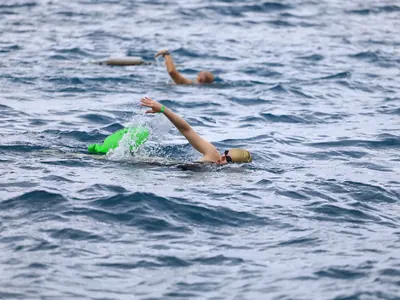
Pick the camp that fits your goal: Swim Up Winter in an indoor pool, Summer, or Open Water.
Once you have applied, before swim camp covers the weeks that follow.
Try the plan for a few weeks. When you can swim the distance comfortably and want your stroke looked at properly, request a place on the application page.
Have your place ready for the next camp.
Ask about datesHave your place ready for the next camp.
Ask about datesHave your place ready for the next camp.
Ask about dates