

Swim Camp Prerequisites: Why 200 m?
Winter and summer camps ask for 200 m without stopping; open water asks 400 m and a day-one pool check. Test yourself and see what to do if you fall short.
In short: Winter and Summer camps ask for 200 m without stopping; Open Water camps ask for 400 m and a pool check on day one. The measure is distance, not speed. To see which camp fits you, try Is this camp right for me?.
Most swim camps ask for something before you arrive. Ours is a distance, and we say it plainly. This note explains the numbers, how to check where you stand and what to do if you are not there yet.
Prerequisites are set per camp and can change, so always check the page of the camp you are interested in.
Why we ask for continuous distance
A camp is dense. There are two pool sessions a day, video review between them and dryland work in the afternoon. To get anything from it, you need to be able to swim while thinking about your stroke.
If every length is a struggle, your attention goes to breathing and survival, and technique work does not stick. If you can swim a modest distance steadily, your attention is free for the things we are there to change.
There is also the group. A coach divides attention across a lane. A lane works best when everyone can finish the set.
So we ask for a distance, not a speed. We do not set an age limit, a pace or a competitive background. Distance, continuous, is the only measure.
How to test 200 m without stopping
The prerequisite for Swim Up Winter and Swim Up Summer is 200 m without stopping.
Test it like this:
- Choose a pool. A 25 m pool means eight lengths, a 50 m pool means four.
- Warm up with a few easy lengths.
- Swim at a pace you could hold for a long time. Not a race. Any stroke is fine, and freestyle is not required.
- Do not touch the bottom or hold the wall. A turn is fine, a pause is not.
- Count calmly, or ask a friend to count.
If you finish and feel you could carry on a little, you meet the requirement. If you finish gasping, you are close but not there yet.
Stop at any time if you feel unwell. If you have a health condition, check with your doctor before any test like this.
Open water: 400 m and a day-one pool check
Swim Up Open Water asks for more: 400 m without stopping, and a short pool assessment on day one.
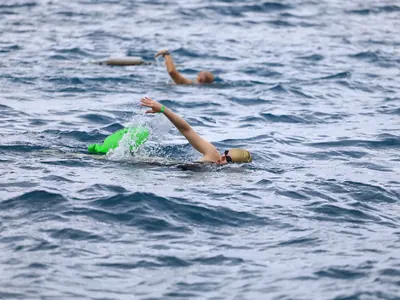
The reason is simple. In a pool you can stop at a wall. In the sea you cannot, and the margin for anything going wrong is smaller. Cold water, chop and a lack of walls all use extra energy. A swimmer who can comfortably cover 400 m in a pool has a reserve.
The day-one assessment is not an exam. It lets the coaches see how you swim, place you in the right group, and check your wetsuit before you go into the sea. It is also where we film your stroke for the first time.
Every session in open water has a support boat and a lifeguard. A tow float is compulsory, and weather, sea state and currents are checked before each session. Even so, the prerequisite is not negotiable, because it is a safety matter.
To test 400 m, follow the steps above in a pool: sixteen lengths of 25 m, or eight of 50 m.
If you fall short
Not there yet? That is common and fixable.
- Build it up gradually. Add a length or two each week. Swim easy intervals, with short rests, then lengthen the intervals.
- Swim regularly. Three short sessions a week usually does more than one long one.
- Slow down. Most people stop because they started too fast.
- Focus on breathing. Breathing out steadily under water takes the strain off.
- Get a lesson. A coach can correct a fault in a session that would take months to find alone. See our note on fear of water if anxiety is part of it.
- Talk to us. Tell us where you are. We would rather give you an honest answer, and a suggestion of when to apply, than see you start a week that is too hard.
Our camps are not a beginner course. We say this clearly so you do not spend money and time on a week that does not suit you yet.
Common questions: age, speed, health
Is there an age limit? No. The camps are for adults.
Is there a speed requirement? No. Only a continuous distance.
Can I stop and rest in the 200 m or 400 m? No. The distance has to be without stopping.
Can I use any stroke? For the test, yes. The camp itself works mainly on freestyle technique.
Does the camp suit people with health conditions? We cannot give medical advice. If you have a heart, blood-pressure or breathing condition, or any other issue, speak to your doctor before you apply.
What if I am close? Apply and tell us. Esra will let you know honestly whether the camp suits you now.
For the wider picture of what a camp involves, read the adult swim camp guide. For the weekly structure, see the adult swim training plan.
More answers are in the FAQ. When you are confident about the distance, request a place on the application page. Our team writes back within 48 hours, and applying commits you to nothing.
Have your place ready for the next camp.
Ask about datesHave your place ready for the next camp.
Ask about datesHave your place ready for the next camp.
Ask about dates