

Dryland for Swimmers: Shoulders and Core
Dryland work for swimmers focuses on shoulder mobility, core control and hip rotation. What to do at home, how often, and how it supports your stroke.
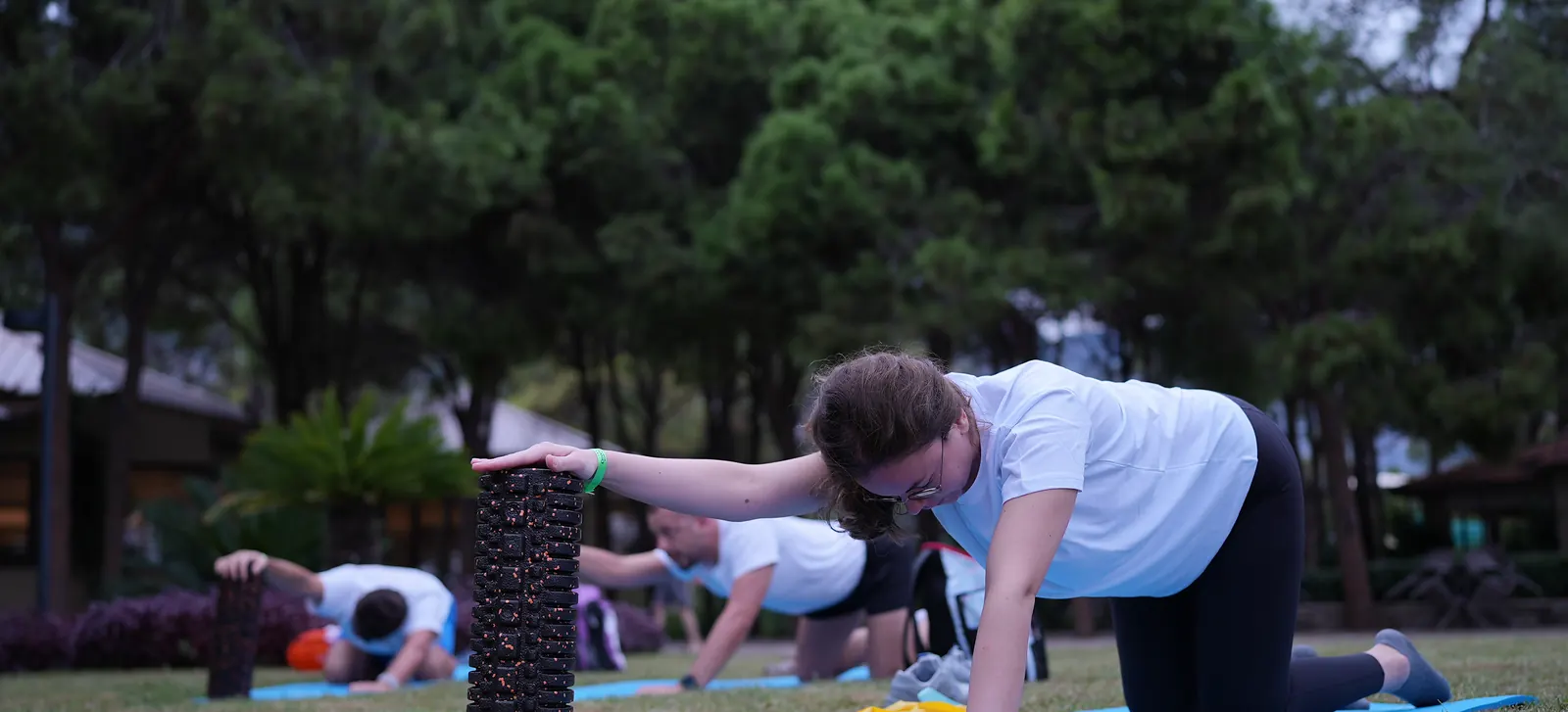
In short: Dryland training prepares the shoulders, trunk and hips on land, where it is easy to feel what you are doing. The aims are modest: mobility, control and readiness to move well in the water. It is general information, does not promise injury prevention and is no substitute for a physiotherapist.
Swimming asks a lot of a small number of joints. The shoulders move through a huge range, thousands of times a session. The trunk holds the body in line, and the hips drive rotation. Dryland training prepares those areas on land, where it is easy to feel what you are doing.
This note covers the purpose of dryland work, a short routine you can do at home and how it fits a camp.
What dryland training is for
Dryland means training done out of the water. For swimmers, the aims are modest and useful:
- Mobility. Enough range in shoulders, upper back and hips to swim long and relaxed.
- Control. Learning to hold your trunk and pelvis steady while your arms and legs move.
- Activation. Waking up the muscles you want working before you swim.
- Awareness. Learning how it feels to rotate, reach and brace, in a place where you can slow down.
It is not about building bulk. Dryland done well helps you feel and repeat the positions you are trying to swim. Most swimmers gain more from short, regular sessions than from long ones.
Shoulder mobility: a simple routine
Here is a gentle routine, about 10 minutes. Move slowly, breathe, and stop if anything pinches or hurts.
- Arm circles. Standing, make small circles with straight arms, then bigger ones. Ten each way.
- Thread the needle. On hands and knees, slide one arm under your body and rotate your upper back, then reach up. Eight each side.
- Wall slides. Stand with your back to a wall, arms against it in a “goalpost” position, and slide your arms up and down. Ten slow repeats.
- Band pull-aparts. With a light resistance band, pull your hands apart at chest height. Ten to twelve repeats.
- Child’s pose with reach. Kneel, sit back and stretch your arms forward along the floor. Hold for several slow breaths.
Safety note: do not push into pain. A stretch should feel like gentle tension, not a sharp or pinching sensation. If you have a current shoulder problem, ask a physio before starting.
Core and hip control
“Core” here means the trunk muscles that keep your body in a line. In the water, a stable trunk lets your arms and legs work without wobbling.
Try these, 2 or 3 rounds:
- Front plank. Forearms and toes on the floor, body in a line. Start with 20 seconds and build up gradually.
- Side plank. On one forearm, hips lifted. Start with 15 seconds each side.
- Dead bug. On your back, arms and knees up. Lower opposite arm and leg slowly while keeping your lower back still. Eight each side.
- Glute bridge. On your back, feet flat, lift your hips. Ten repeats, with a short pause at the top.
- Hip circles or 90/90 stretches. Gentle hip mobility, to let the legs move freely.
Quality matters more than number. If your lower back aches during a plank, shorten the hold or ask for advice on form.
Rotation and the catch
Two things on land transfer directly to swimming.
Rotation. Freestyle uses body roll, led by the hips and shoulders. Practise by lying on your back or side and slowly rolling from one side to the other, letting the hips lead and the head stay quiet. Try it standing, with arms out, turning smoothly from the hips.
The catch. The catch is the moment the hand and forearm take hold of the water. On land, you can rehearse the shape with a band: attach it to a fixed point, reach forward and pull with a high elbow, forearm facing back. Slow, small movements teach more than big ones.
None of this replaces watching your stroke. At our camps, a coach reviews your footage and picks the changes worth making. Dryland then supports those specific changes. See the method page for the process.
How often to train on land
For most adults, little and often works best.
- Two or three short sessions a week, of 15 to 20 minutes, alongside your swimming.
- A shorter mobility routine before a swim, five minutes or so.
- Easier on heavy swim days, so you arrive at the pool fresh.
- Consistent over time, not a burst before an event.
Stay with exercises you can do well. If you are tired, a lighter day beats a sloppy session.
Warning signs: when to rest or see a physio
Swimmer’s shoulders are a common complaint, and dryland work is not a guarantee against them.
Rest, and consider seeing a physiotherapist or doctor, if you notice:
- pain that persists, or that wakes you at night;
- a sharp pinch at the front or top of the shoulder when you reach overhead;
- numbness, tingling or weakness in the arm;
- pain that gets worse with each session.
Do not train through pain. We are coaches, not clinicians, and cannot diagnose or treat injuries.
Dryland at camp
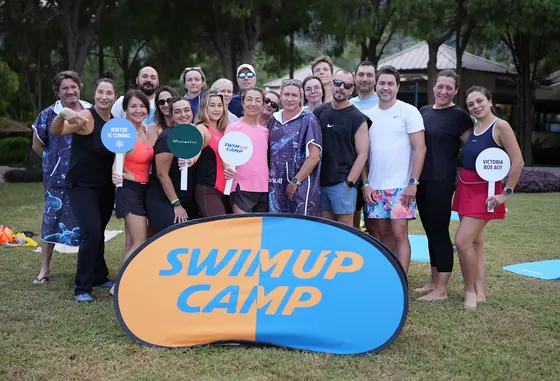
Dryland is part of the camp day. A session in the afternoon, between the video analysis and the second pool session, covers mobility, activation and core work chosen to support what you are changing in the water. Breathwork and yoga in the evening help the body recover.
You can see how it fits in A day at camp, and Swim Up Winter has the full camp description.
For swimmers who have plateaued, see technique before volume. For the weekly structure, see the adult swim training plan.
If you have a question about whether dryland work suits you, or about your own shoulders, write to us first and we will talk it through.
Your level, your goal, which camp: a short talk with our team.
Talk to us firstYour level, your goal, which camp: a short talk with our team.
Talk to us firstYour level, your goal, which camp: a short talk with our team.
Talk to us first