

Before Swim Camp: How to Prepare for Day One
What to do in the weeks before camp: write down your goal, test the prerequisite, film your own stroke and arrive rested for the day-one measurement session.
In short: Before camp, narrow your goal to one sentence, check that you can swim the prerequisite distance comfortably, film your own stroke and arrive rested in the last week. The first days of camp are about measurement: groups are split by level and your stroke is filmed underwater. For the hour-by-hour rhythm of a camp day, see A day at camp.
Once you have applied to a swim camp, most people are left with the same question: what should I do now? Train harder? Rest? Try every drill I know one more time?
The answer is simpler than that. Arrive at camp clearer, not fitter. A camp exists so you can see your stroke as it is and choose three things to correct. This note covers the practical side of preparing for camp: what to do beforehand, what happens when you are filmed and what not to expect.
What happens after you apply?
Applying is not binding and it is not a selection process. It is the start of a conversation so we can place you in the right group. Our team writes back within 48 hours and shares the camp’s full programme and details in writing. Each camp has its own programme, prepared for that camp, and times can change from one camp to the next.
At this stage the most useful thing you can have is a clear idea of why you are coming. The rest of the preparation follows from it.
Five things to do before camp
1. Reduce your goal to one sentence. “Swim better” is a direction, not a goal. “My hips drop when I breathe and I want to fix it” or “I want to feel at ease in the sea” is a goal. An open water camp does not have to be a race camp. If you tell us your goal up front, the programme can be shaped around it.
2. Test the prerequisite. Winter and Summer camps ask for 200 m without stopping, Open Water camps for 400 m. Swim it at your own pace and notice whether your breathing is under control at the end. The detail is in our note on prerequisites.
3. Film yourself. We will record your stroke at camp anyway. A phone clip taken beforehand helps you arrive knowing what you want to look at. Write two or three notes on what you see. More on filming in the piece on video analysis swim camps.
4. Write down your questions. Things you want to ask a coach are forgotten within days. Keep a short list: a niggle, a habit, a fear.
5. Do not arrive tired. In the final week, cut your volume and protect your sleep. A camp has a full rhythm, and being fresh on day one raises the quality of the first analysis. For the training side, see the adult swim training plan.
Packing is a separate list, covered in what to pack for a swim camp.
Measurement: swim as you are
When you are filmed, the job is not to swim well. It is to swim as you are. The underwater camera records (from the surface too, when conditions allow), and the aim is to see what your stroke actually looks like. Do not tidy it up or try to look good. The more clearly your habits show on camera, the more accurate the correction.
You then watch the footage with a coach. The aim is not to see everything but to choose three priorities for the sessions ahead. Groups are split by level and the programme scales to your current volume; nobody is put into a set they cannot finish.
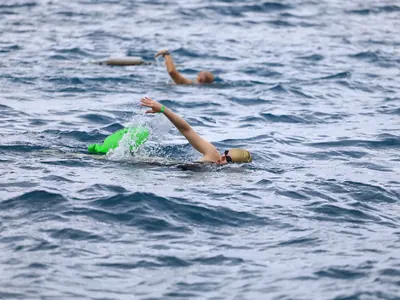
At an Open Water camp, day one is a short pool assessment, underwater filming, a first try in the wetsuit and a safety briefing.
What to expect, and what not to
You can expect: a full pace, plenty of repetition, planned rest and a look at your own footage. Sometimes the footage shows a different stroke from the one you feel. That is useful information.
Do not expect: a holiday, a race, or everything fixed in four days. The camp gives you a clear plan and a first change you can see; the rest is practice. We make no promise about speed or results.
After camp
Your footage and analysis notes are shared with you digitally after camp, and you leave with your three priorities and a drill list for them. Arriving with notes of your own makes it easier to carry on afterwards.
For the wider picture of what a camp involves, read the adult swim camp guide.
When you are ready, look at the Winter, Summer and Open Water pages. If you are unsure about your level, write to us first and we will talk it through. You can meet the coaches on the team page.
Photos and short films from camp.
See the photosPhotos and short films from camp.
See the photosPhotos and short films from camp.
See the photos