

Overcoming Fear of Water as an Adult
Fear of water as an adult: where it comes from, how breathing and buoyancy help, and when to start with a lesson, not a camp. Step by step.
In short: Fear of water has several possible causes, and many adults carry it quietly. The usual building blocks are breathing, buoyancy and stopping safely. This note helps you decide whether a lesson or a camp should come first. It is practical guidance, not therapy.
Many adults are uneasy in water, and few say so. Some can swim but dislike the deep end. Some avoid putting their face in. Some have not been in a pool since childhood and would rather not find out how they feel.
If that sounds familiar, you are not unusual, and there is nothing to be embarrassed about. This note explains where the unease can come from, the building blocks that tend to help, and how to decide where to start.
Where does fear of water come from?
There is rarely a single cause. Common ones include:
- A frightening moment. Being pulled under, swallowing water or feeling out of your depth as a child.
- Never learning properly. Some people picked up a stroke without learning to breathe or float, so they feel unsafe the moment their feet leave the bottom.
- Not being able to see or stand. Deep water and dark water remove the usual cues.
- Loss of control. Water takes away your normal grip on the world. Some people dislike that feeling in itself.
- Hearing or sensory discomfort. Water in the ears or nose can feel alarming.
Understanding the source helps you pick the right first step. It does not need to be dramatic, and you do not have to explain it to anyone.
Breathing first
On land you breathe without thinking. In water you have to plan it. Most of the panic that adults describe is really a breathing problem: they run out of air because they hold their breath, then lift their head and gasp.
A few principles from beginner guidance:
- Do not hold your breath. Breathe out steadily under water, through the nose or mouth, then breathe in when your face is clear. A slow, continuous exhale feels very different from a held breath.
- Start in shallow water. Stand at a depth where you feel safe, put your face in briefly and blow bubbles.
- Repeat until it is dull. A skill feels easy when you stop thinking about it, which comes from repetition, not courage.
- Take breaks. Short, calm sessions work better than one long one in which you tense up.
Do this with a teacher or a friend you trust if that helps. The point is to make breathing in water ordinary.
Buoyancy: trusting the water
Water holds you up more than you expect. Most people float, especially with their lungs partly full, though how well depends on body composition. A lot of fear comes from not knowing this.
Ways to explore buoyancy:
- Holding the wall. Let your legs float behind you while you keep a hand on the wall.
- A float or a pool noodle. Use it for reassurance, then rely on it less over time.
- Floating on your back. Relax your head into the water, ears submerged, and breathe slowly. Many people find this the most reassuring position, because the face is out of the water.
- A gentle push and glide. Push off the wall and glide a short distance, then stand.
The RNLI also teaches a “float to live” method for emergencies: lean back, extend your arms and legs and keep floating until you control your breathing. It is a good thing to learn even if you are comfortable in the water.
Stopping safely and standing up
Anxiety eases when you know how to stop. Before you try anything more, learn how to:
- Return to the wall from a few metres away.
- Stand up from a floating or horizontal position. Bring knees under you and put your feet down.
- Rest by holding the wall, a lane rope or a float.
- Signal to a lifeguard or teacher that you need help.
Practise each one until it is boring. Knowing that you can stop is what makes it possible to continue.
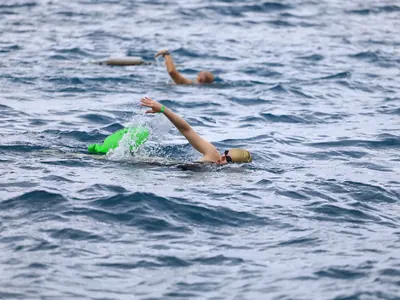
Always swim where there is a lifeguard or a teacher, and tell someone before you go. In open water, swim with others, wear a bright tow float and avoid cold water until you are confident in a pool.
Lesson or camp: which comes first?
A camp is not a course for people learning to swim. Our requirement is 200 m without stopping for Winter and Summer camps, and 400 m with a pool assessment for Open Water.
If the idea of 200 m feels far away, start with lessons. Look for an adult beginner class or a teacher who works with anxious swimmers. A few sessions of confidence work can change how you feel more than any amount of effort alone.
Signs you are ready to think about a camp:
- you can swim 200 m, even slowly, without stopping;
- you are comfortable putting your face in the water and breathing out;
- you know how to rest, stop and stand;
- you want to improve your stroke rather than learn the basics.
If you are somewhere in between, tell us. We would rather give you an honest answer than have you start a week that is too hard. The FAQ covers prerequisites, and you can read about our approach on the method page.
When to speak to a professional
Some fears go beyond what practice can fix. Consider speaking to a doctor, a qualified therapist or a specialist teacher if:
- fear of water brings on panic attacks, or affects your sleep or daily life;
- you have a medical condition, such as a heart or breathing problem, that makes swimming risky;
- you have had a traumatic experience in water that you cannot shake.
Camps and coaches, including ours, are not a replacement for that kind of help. We coach swimming technique. Details of our coaches are on the team page.
For the wider picture of what a camp involves, read the adult swim camp guide. For the weekly structure, see the adult swim training plan.
Start with a lesson. When you can swim 200 m without stopping and want to refine your stroke, talk to us about a camp. If you are unsure where you stand, write to us first and Esra will give you an honest answer.
Your level, your goal, which camp: a short talk with our team.
Talk to us firstYour level, your goal, which camp: a short talk with our team.
Talk to us firstYour level, your goal, which camp: a short talk with our team.
Talk to us first