

Open Water Sighting: How to Swim Straight
Sighting is how you stay on course in open water. Learn how high to lift your head, pick landmarks and practise before a race or camp.
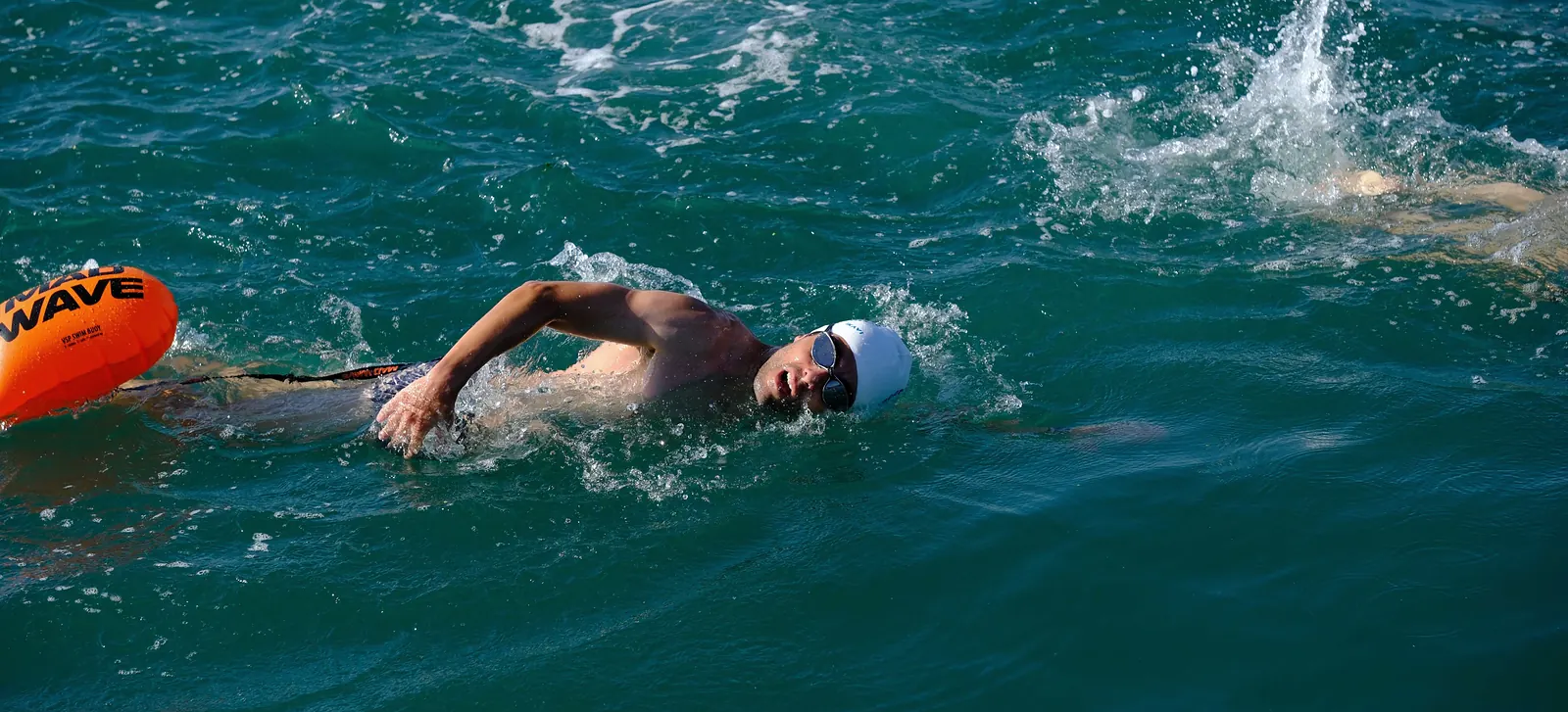
In short: Sighting means briefly lifting your eyes above the water to check your line against something fixed, then returning to your stroke. It is done every so often, not every stroke. This guide covers how high to lift, choosing landmarks, waves and sun, pool drills and race-day practice.
In a pool, the black line does your steering. In open water, nothing does. Without a lane or a wall, even strong swimmers drift, and a drift of a few degrees adds metres you did not plan to swim.
Sighting is the skill that fixes this. It is simple to describe and takes practice to do without wrecking your stroke.
What sighting is and why it matters
Sighting means lifting your eyes above the water, briefly, to check your line against something fixed, then dropping back into your stroke. It is done every so often, not every stroke.
Why it matters:
- Distance. Every metre off the straight line is a metre added. Over a long swim it counts.
- Safety. You see boats, other swimmers and the shore.
- Energy. Fixing your line early costs less than correcting late.
- Race craft. On a course marked by buoys, a straighter line is a faster one, and the World Aquatics open water rules are built around swimmers rounding buoys in order.
Most swimmers drift because one arm pulls harder than the other or because they breathe on one side. Sighting turns a drift into a quick correction.
How high to lift your head
There is no magic number, and we will not give one. The right height is the minimum that lets your eyes clear the water.
Think of it this way:
- Eyes, not chin. Lift just enough to see forward. A high head drops your hips and legs, and slows you.
- Keep the stroke going. Sight as one arm enters the water, so the lead arm supports you.
- Look, then breathe. Many swimmers sight forward, then turn to breathe to the side in the same stroke, as one smooth movement.
- Keep it quick. A long look ruins your rhythm.
A useful cue is “crocodile eyes”: only the top of the head and eyes rise above the surface, and the rest of the body stays low. Practise it slowly at first and let your coach or a friend watch from the side.
Because bodies and strokes differ, check the movement on video. A head that lifts too high is easy to spot from the side and easy to fix once you see it.
Choosing landmarks
A landmark is anything that stays still and is easy to spot. Pick it before you start.
- Big and tall beats small and low. A building, a tree or a tower is easier to see than a buoy.
- Use two. A near marker, such as a buoy, and a far one behind it. If the two line up, you are on line.
- Check the far shore. Rock shapes, chimneys and masts are good reference points.
- Ask the organiser. At races, the briefing usually names the buoys and the turn marks. Learn the colours and the order.
- Sight on buoys when you can, but remember they move and are hard to see in chop.
On a camp, you learn the course in advance. At a race, take time to walk the beach, look along the course and choose.
Waves and sun
Conditions change what you can see.
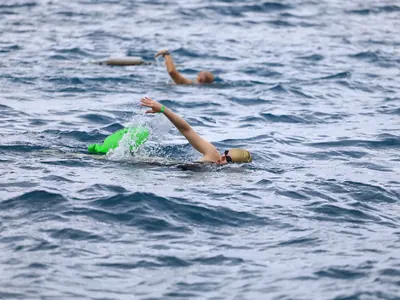
Waves. In chop or swell, you may only see ahead when you are on a crest. Time your sighting to the lift of the water, and sight less often if you need to. Breathe away from the wave if you can, so you do not swallow water.
Sun. Low sun behind a buoy can blind you. Tinted goggles help, and so does picking a landmark off to one side. If you cannot see, trust your stroke and sight again a few strokes later.
Current. Sideways drift can push you off line without your noticing. A landmark that moves relative to a fixed point behind it tells you.
Other swimmers. In a crowd, sighting also means checking where people are. Look, then adjust your line, rather than following the nearest feet.
Pool drills for sighting
You can practise a lot in a pool.
- Head-up swimming. Swim a few strokes with your head up, then return to normal. Notice what happens to your legs.
- Sight every third stroke. Pick a point on the pool wall, a clock or a post, and look at it on a regular count.
- Sight and breathe. Practise the combined movement: eyes forward, then breathe to the side.
- Eyes closed. Swim a few strokes with your eyes shut, then open them and see where you ended up. It shows you how you drift.
- Lane line to lane line. Swim between two lane lines without touching either.
Keep each drill short, and film it if you can. We cover the camera work on the method page.
Race-day practice
Before a race:
- Walk the course from the shore and note the first and second landmarks.
- Do a short warm-up swim and sight a few times while you are loose.
- Start wide or behind if you are nervous, so you have room to look.
- Sight early after the start, then settle into a pattern.
- Check at each buoy turn, because the next leg often looks different from the last.
If you want to practise this in a sheltered bay with a support boat and a lifeguard, our Open Water camp covers sighting, buoy turns, mass starts and pacing. You see a sample day on A day at camp. The prerequisite is 400 m without stopping and a short pool assessment on day one.
If a race is the goal, your first triathlon swim walks through race day. For fit and rules, read the swim wetsuit guide.
If sighting is the skill you most want to fix, request a place on an open water camp and tell us that on your application.
Have your place ready for the next camp.
Ask about datesHave your place ready for the next camp.
Ask about datesHave your place ready for the next camp.
Ask about dates