

How to Choose an Open Water Swim Camp
Before booking an open water swim camp, check prerequisites, safety cover, group levels, what is included and how you get feedback. Seven questions.
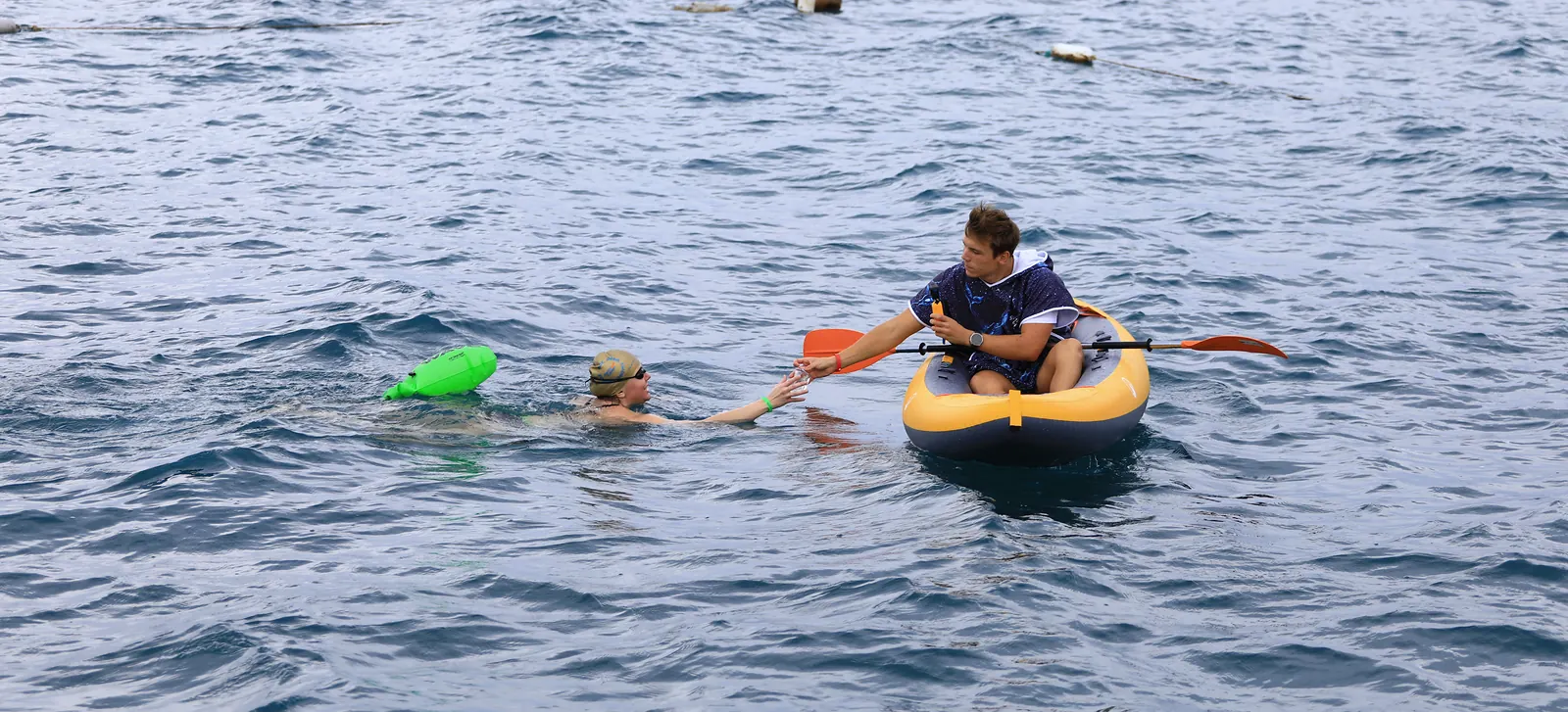
In short: Compare open water camps on structure, not scenery: the prerequisite, safety cover (escort boat, lifeguard, water checks), group levels and feedback, and what is included. The guide ends with seven questions to ask before you apply. Our own set-up is on the Open Water camp page.
Open water camps look alike from the outside. A bay, a few buoys, a group in wetsuits. What separates a good week from a frustrating one is rarely the scenery. It is the structure behind it: who checks the water, who watches you swim, and what you take home afterwards.
This guide gives you a way to compare camps before you commit. It applies to any operator, including us.
What makes open water different from a pool?
A pool gives you a black line, a wall every 25 or 50 metres and flat water. Open water takes all three away.
- No lane rope, no wall. You steer yourself. Swimming straight becomes a skill of its own, which is why sighting gets so much coaching time.
- Moving water. Chop, swell and current change your stroke rhythm and your breathing pattern.
- Other swimmers. Mass starts, buoy turns and drafting put you in contact with people, which no lane etiquette prepares you for.
- Temperature and visibility. Cold water affects breathing first and muscles second.
The World Aquatics open water rules treat all of this as part of the discipline: courses are set around buoys, with feeding, safety craft and water-temperature limits written into the competition framework. A camp that teaches open water should be teaching the same things, at a pace you can absorb.
The practical point: pool fitness is the base, not the whole job. A camp should add the missing skills rather than simply move your usual sets to a bigger pool.
Prerequisites: what distance and speed?
Look for a stated, testable prerequisite. A camp that says “all levels welcome” without a number has not thought about its water.
Ours is plain. For Swim Up Open Water you need to swim 400 m without stopping, and we run a short pool assessment on day one. That is a continuous distance, not a time. We do not ask for a pace, an age or a competitive background.
Why a distance and not a speed? Because in open water the risk is not being slow. It is stopping with nothing to hold. A swimmer who can keep going calmly for 400 m in a pool has the aerobic base to be coached at sea.
When you read another operator’s requirements, ask:
- Is the distance continuous, or the total of a set?
- Is it tested in the pool before anyone enters the sea?
- What happens if you fall short: a refund conversation, or a different camp?
If you are unsure whether you qualify, our note on prerequisites explains how to test yourself.
Safety: escort boat, lifeguard and water checks
Safety is the part you cannot judge from a photograph, so ask for it in writing. The RNLI’s guidance for beginners is a useful benchmark: do not enter cold water suddenly, swim with others rather than alone, carry a brightly coloured tow float and know how to rest on your back if you tire.
A camp should be able to tell you:
- Cover on the water. A support boat and a lifeguard at every session, not just the first.
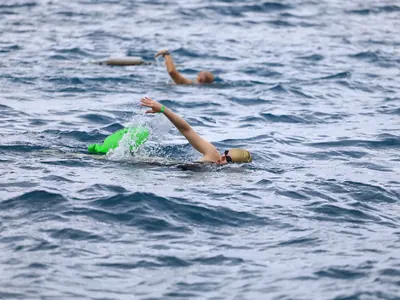
- Visibility. Whether every swimmer wears a tow float. On our open water camps a tow float is compulsory, and it is easy to spot from the boat.
- Conditions check. Who decides, and when. We assess weather, sea state and currents before each session.
- Emergency plan. A written plan and a line to the nearest medical centre.
- Venue choice. Sheltered bays with manageable boat traffic, with room for a boat and a lifeguard.
Be careful with vague language. “Safety is our priority” is not information. “A lifeguard and a support boat at every session” is.
Group levels and one-to-one feedback
Two numbers matter more than the brochure photograph: how many swimmers each coach watches, and how the groups are formed.
Ask whether groups are split by level and who decides. At Swim Up the day-one pool assessment is what places you, and nobody is put into a set they cannot keep up with.
Then ask what feedback looks like. Some camps coach from the boat with a few words between sessions. Others film you and review the footage with you. We film underwater, with surface or drone footage when conditions allow; national swimming coaches review it with you frame by frame, explain your faults and agree three priorities with you. The full process is on the method page.
Whatever the camp’s approach, find out:
- Will anyone look at your stroke individually?
- Is there a record you can keep, or only advice you must remember?
- Does the coach explain why, or only what?
What is included? Accommodation, meals and coaching
“All inclusive” means different things in different places. Ask for the list.
With us, every camp is a package: accommodation, meals and coaching are included, plus underwater technical analysis when the camp announcement includes it. Two things are not: a wetsuit and airport transfers. You bring your own wetsuit; none is provided or hired out at camp. After you apply we share a wetsuit recommendation based on the water temperature, and you try it in the pool on day one. Travel and rooming details are sent in writing.
We do not publish prices on the site. Cost and payment terms are sent after your application, and applying commits you to nothing.
When you compare camps on cost, compare like with like. Check:
- Is analysis included, or an extra?
- Are boat and lifeguard cover included, or charged per session?
- Are meals included every day?
- Do you keep your footage?
On that last point: your recordings and analysis notes are shared with you digitally after camp.
Seven questions to ask before you apply
Copy these into an email to any camp you are considering.
- What exactly is the prerequisite, and how is it tested?
- What safety cover is on the water at every session?
- Is a tow float compulsory?
- How are groups formed, and how many swimmers does each coach watch?
- Will I be filmed, and will I keep the footage?
- What is included, and what do I bring or rent myself?
- Where exactly is the camp, and how do I get there?
A good operator answers these without hesitation. If the replies are slow or vague, that tells you something too.
If you would like our answers to all seven, they are on the open water camp page and in the FAQ. When you are ready, request a place on the application page. Our team writes back within 48 hours.
Have your place ready for the next camp.
Ask about datesHave your place ready for the next camp.
Ask about datesHave your place ready for the next camp.
Ask about dates