

Swim Holiday or Swim Camp? How to Choose
Swim holidays and swim camps look alike but serve different needs. Compare coaching depth, group size, what is included and feedback before you pick one.
In short: A swim holiday is a holiday organised around swimming; a swim camp is a week built around improving your stroke. Neither is better, and choosing the wrong one is the main cause of disappointment. The note compares coaching depth, group size, costs and who each one suits.
Both involve swimming in a lovely place with other swimmers. Both are sold with photographs of bays and pools. The difference is not in the pictures. It is in what the week is built to do.
This note offers a fair comparison, without naming operators.
Swim holiday: what you get
A swim holiday is a holiday organised around swimming. Typical features:
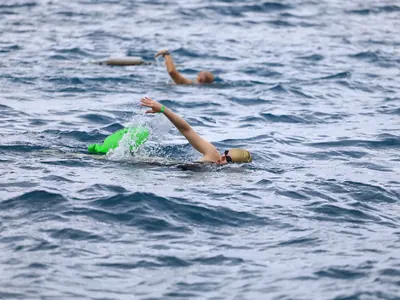
- A route or a place. Swimming from island to island, along a coast or across a lake.
- Guides. Often the guide handles navigation and safety, and may offer tips.
- A relaxed pace. Several swims a day, with time for lunch, sightseeing and rest.
- A mixed group, often with a wide range of abilities, because the swims are set for enjoyment.
- Accommodation and transport arranged for you.
The goal is the experience: the places, the company and the sense of covering distance. If you want a week of swimming in beautiful water without thinking about technique, a holiday is a good choice.
Swim camp: what you get
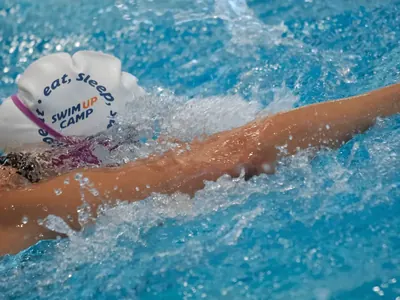
A swim camp is a training block organised around improving how you swim. Typical features:
- A programme. Sessions with a purpose: technique, endurance, open water skills.
- Coaching throughout. Coaches watch you swim and tell you what to change.
- Feedback methods. At ours, video analysis, with three priorities and a comparison at the end.
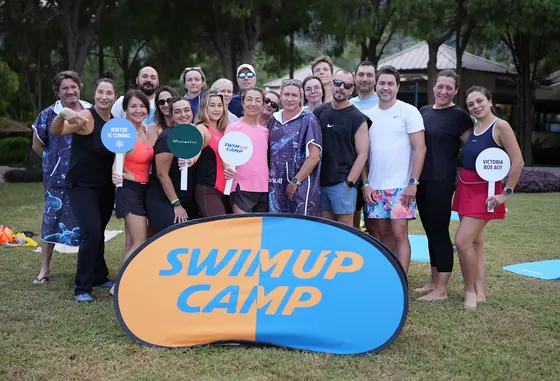
- A group built for the work. Placed by level, so that sets suit you.
- Dryland, recovery and theory alongside the swimming.
- A record of what you worked on.
The goal is change: leaving with a better stroke and a plan. If you want to swim differently when you get home, a camp is built for that.
Coaching depth and feedback
This is the biggest difference, and the one worth asking about directly.
| Question | Holiday | Camp |
|---|---|---|
| Who watches your stroke? | A guide, mainly for safety | Coaches, for technique |
| How is feedback given? | Often spoken, occasionally | Planned, often filmed |
| Do you get a record? | Rarely | Often, in our case footage and notes |
| Is progress the point? | Not usually | Yes |
| Is there repetition on one thing? | No | Yes |
Many holidays include helpful advice, and some include coaching sessions. The question is how central it is. If you want to know whether your stroke has changed, look for a way of checking.
At our camps we film your stroke underwater; national swimming coaches review the footage with you frame by frame, explain your faults and agree three priorities. See the method.
Group size and levels
Ask both questions of any operator.
How many swimmers per guide or coach? A smaller ratio gives more attention. Numbers vary widely and we do not quote an industry average.
How are levels handled? In a holiday, the swims are usually the same for everyone, with the faster swimmers going ahead. In a camp, groups are formed by level so that everyone can finish the set. Ours are placed after the day-one assessment, and nobody is put into a set they cannot keep up with.
Prerequisites tell you something too. A holiday may ask for a modest distance or none. Our camps ask for 200 m without stopping (Winter and Summer) or 400 m (Open Water), because the work is dense. See prerequisites.
Costs, included items and extras
We do not compare prices, because any figure goes out of date, and we cannot verify other operators’ current rates. Compare what is included instead.
Check the following for each option:
- accommodation and meals;
- coaching, and whether it is included or extra;
- video analysis, and whether you keep the footage;
- boat and lifeguard cover on open water;
- equipment, such as wetsuit hire;
- airport transfers.
For us, every camp is a package: accommodation, meals and coaching are included, plus underwater technical analysis when the camp announcement includes it. A wetsuit and airport transfers are not: you bring your own wetsuit, and none is provided or hired out. We do not publish prices on the site. Cost and payment terms are sent after your application, and applying is not binding.
Which one fits you?
A short guide.
A holiday suits you if:
- you mostly want to enjoy the water, the place and the company;
- you already swim well enough and do not want to change anything;
- you prefer a relaxed pace.
A camp suits you if:
- you want to change your stroke or fix a specific problem;
- you are preparing for a race, a triathlon or a crossing;
- you like structure, feedback and a plan;
- you want a record of what you did.
Both are fine if you are happy to combine them: a camp in the winter to rebuild technique, and a holiday in the summer to enjoy it.
For the wider picture of what a camp involves, read the adult swim camp guide. The criteria are set out in how to choose an open water swim camp.
If you decide on a camp, look at Swim Up Winter, Summer or Open Water, and read the FAQ. When you are ready, request a place on the application page. Our team writes back within 48 hours.
Have your place ready for the next camp.
Ask about datesHave your place ready for the next camp.
Ask about datesHave your place ready for the next camp.
Ask about dates